
In short
A trellis can move a cucumber crop upward, make fruit easier to find and reduce contact with soil. It also catches wind and needs regular training. Design something you can reach and maintain before the vines become tangled on the ground.
A trellis can move a cucumber crop upward, make fruit easier to find and reduce contact with soil. It also catches wind and needs regular training. Design something you can reach and maintain before the vines become tangled on the ground.

From the Namibian discussions
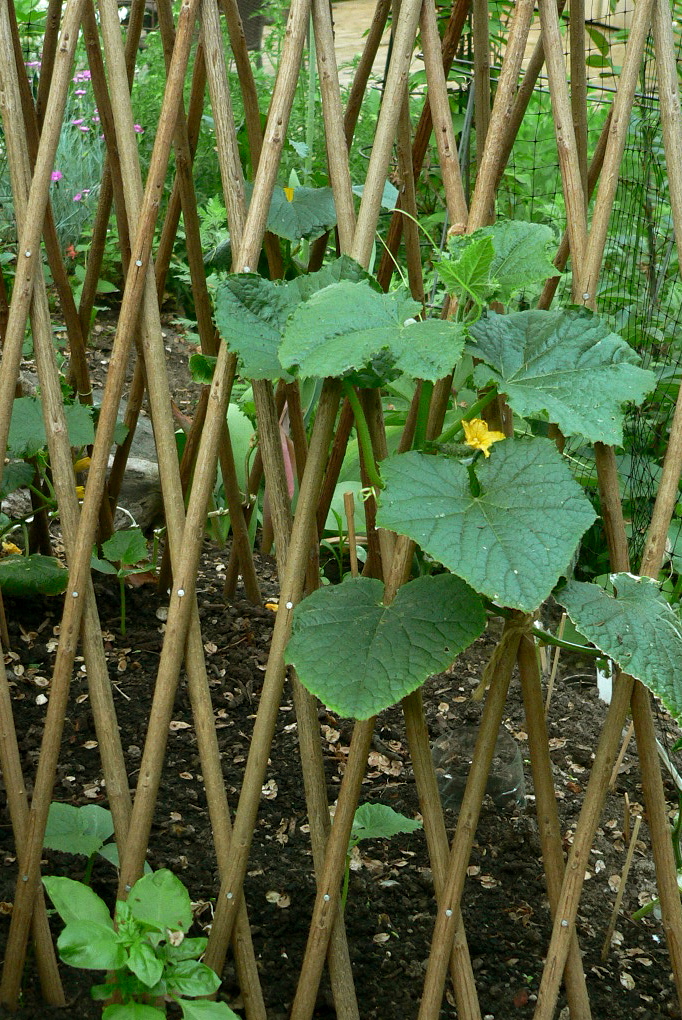
A cucumber-trellis idea was saved in the Namibian collection as a visual inspiration. The message did not report its dimensions or performance. The useful next step is a small, accessible support suited to your courtyard, wind exposure and cucumber variety.
Choose the plant and position
Vining cucumbers can use vertical support; compact types have a different growth habit. University of Minnesota guidance notes the benefits of supported vines and the need to guide growth. Put the structure where it will not shade a crop that needs full sun or obstruct a shared path.
Build for access and wind
- Use sound supports with no sharp edges or exposed wire ends.
- Anchor the frame for the loaded vine and local wind conditions.
- Keep the top within comfortable reach for harvesting.
- Install the trellis before planting or before roots occupy the support positions.
Train little and often
Guide young shoots gently toward the support and use loose, suitable ties where needed. Check ties as stems thicken. Keep harvest access on at least one side and inspect fruit hidden behind leaves. A trellis does not reduce the plant’s need for an adequate root volume, nutrients and reliable water.
Compare the real benefit
Record how much ground space is used, how long training takes and how much sound fruit is harvested. If wind repeatedly tears leaves or the frame becomes hard to reach, change the design before repeating it. In a shared garden, teach the next person how the ties and harvesting routine work.
Namibian climate and microclimate
Wind can be more limiting than floor space in exposed Namibian gardens. A porous windbreak may help, but a solid barrier can create turbulence. Check the soil below the trellis, since a small planted footprint can dry quickly even when the canopy looks lush.
Your first practical step
Build one short, reachable section and grow a few plants against it before covering an entire boundary.
Keep exploring
Sources and further reading
Have you tried this in Namibia? Share the site conditions, method and result—including what did not work—with the Living Earth community. Local observations help the next person adapt the idea.
Worthwhile videos
Made by others, mostly outside Namibia: watch for the idea, then adapt it to our dry climate.
Publisher: ABC Gardening Australia
Country and context: Australia; exact filming locality not confirmed.
A practical lesson about supports for climbing plants. Match strength, access and dimensions to your own crop.
Use the support principles from the demonstration; choose locally available materials and strengthen the frame for your wind exposure.
Keep exploring
Hugelkultur
Hugelkultur is a permaculture gardening technique that involves creating raised beds filled with organic materials, such as logs, branches, leaves, and compostable…
Building/sealing earth dams
Building and sealing earthen dams is a vital aspect of water management in farming and agriculture. Earthen dams are constructed using soil,…
Compressed Earth Blocks/Bricks (CEB) House
Compressed earth bricks are eco-friendly construction materials made by compressing a mixture of locally sourced soil, sand, and water. The soil's natural…
A dryland greenhouse: plan heat escape before building
A greenhouse can protect plants from cold and wind, but it can also become too hot within a short time. In a dryland garden, first decide which months and crops need encl…